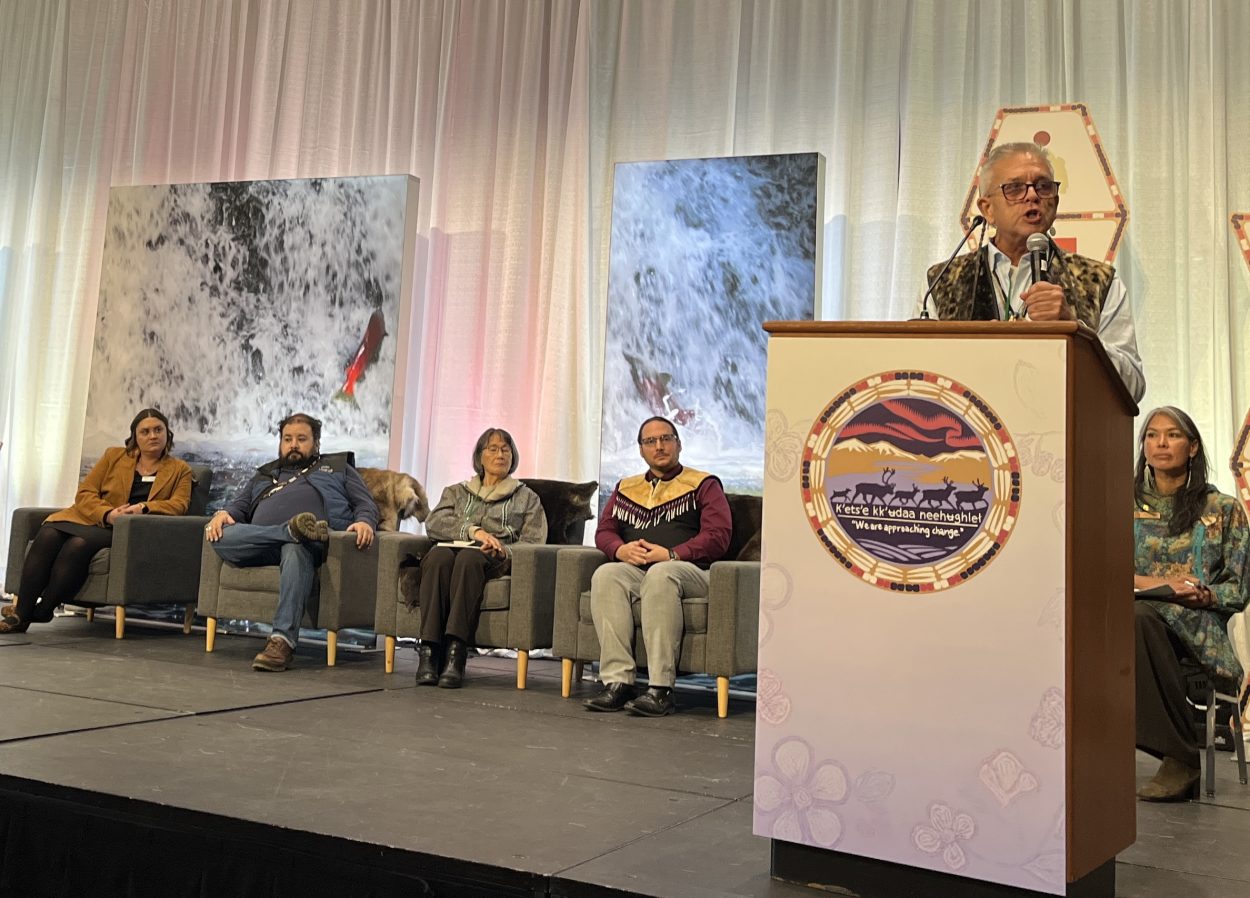
Alaska Native education specialists stressed self-determination and the importance of culture at Tuesday’s Elders and Youth conference in Anchorage.
Ethan Daayoosh Petticrew spent over 30 years in education and holds a master’s degree in K-12 instruction and curriculum. He is Unangax̂ and Tlingit – Yeil of the Kiks.adi from Gagaan Hit – and grew up in Wrangell in Southeast Alaska. He oversees early education for the Central Council of the Tlingit and Haida Indian Tribes of Alaska.
“We should not have to choose between academic excellence and cultural identity. Our children deserve an education that makes them stronger in both worlds. Our children should never have to leave their culture at the door of the classroom,” said Petticrew, followed by applause.
Tlingit and Haida opened culture-based early education programs this year in Craig and Klawock on Prince of Wales Island in Southeast. Petticrew also talked about the tribe’s plans for a 12-acre tribal education campus in Juneau, which will serve students of all ages. Fundraising is ongoing, but it’s expected to cost about $90 million.
“Think about what that represents,” Petticrew said. “Children beginning their education in a culturally grounded preschool, going all the way through university level, where our culture, our language, our identity are interwoven with academic excellence. That is tribal self-determination in action.”
Petticrew was joined on stage by several others, including educator and culture bearer Joel Łiq’a yes Isaak, a member of the Keniatze Indian Tribe from the Dena’ina region in the Kenai Peninsula. He holds a doctorate degree in Indigenous Studies. Isaak highlighted improved test results for Ketchikan students who joined a tribally operated program run by tribal teachers. He said the Western educational system wasn’t serving Native students well, but that has changed.
“Within three months, they’re making years’ worth of growth. It’s amazing,” Isaak said, and the audience applauded. “And that’s because our youth are brilliant. And when the tribe is valuing that brilliance and connecting with language, culture, and creating safety, learning happens very rapidly.”
Tina Náakw Laatseení Woods also spoke to the Elders and Youth crowd. She is Unangax̂ and Chamorro from Guam and is originally from Saint Paul Island. She holds a doctorate in Clinical Community Psychology with a Rural Indigenous Emphasis and has worked in youth wellness programs for decades. She said bringing culture into education could help address the high rates of suicide among Alaska youth. She said her own academic journey was really difficult as a child because she was removed from her mom for seven years, and she suffered from mental health issues.
“Even though I struggled and I had unstable living environments, there were adults in my life,” she said. “My faith and my education has really brought me to where I’m at today.”
The education panel was one of many discussions and workshops held at the Elders and Youth Conference in Anchorage. Hundreds of people participated in the event, which ran from Oct. 19-21 at the Dena’ina Convention Center.